Gabriel Wolff
Abstract Prayer
How alienation allows for immersing in holy texts
Berlin, 2021
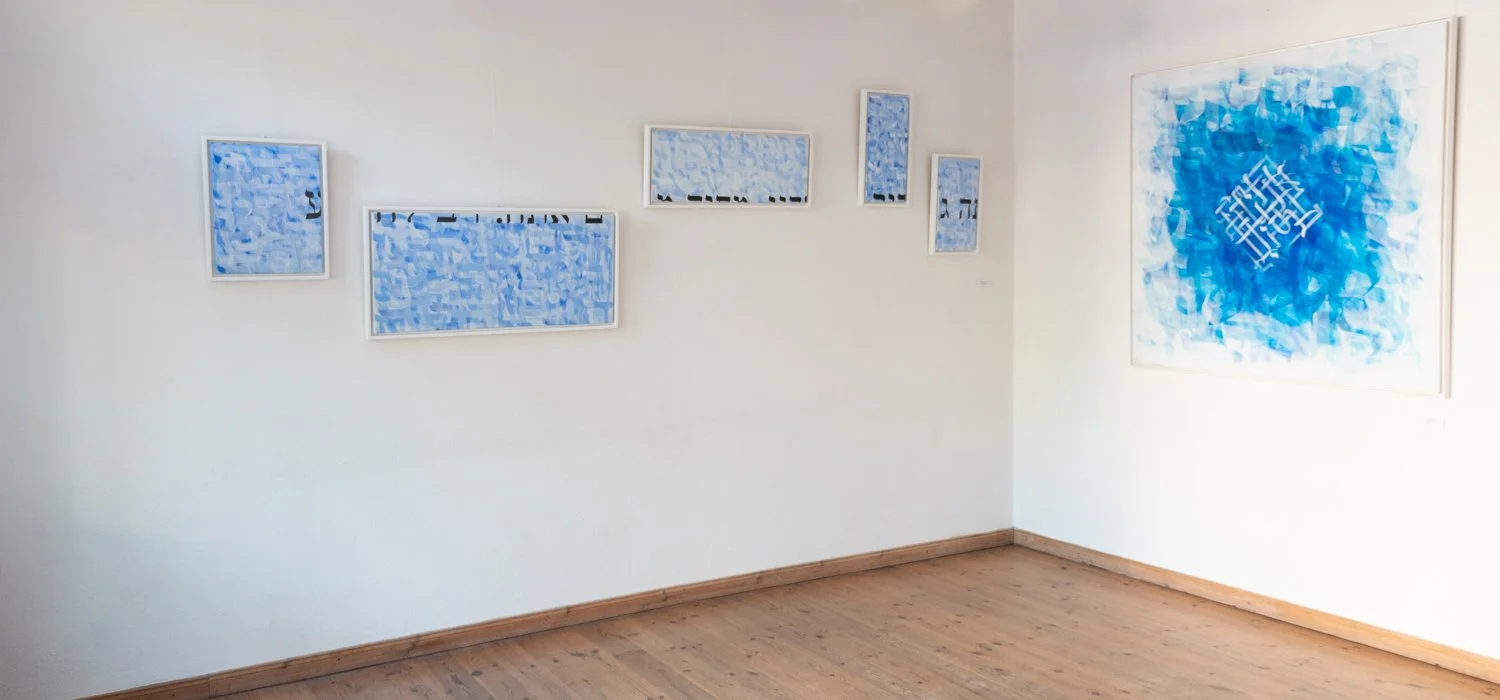
The project Abstract Prayer deals with the fine line between legibility and illegibility, between the concrete and the abstract. The fine line on which prayer, an inherent and essential part of my life, works for me.
It’s an act of alienation, attempting at bridging a gap.Gabriel Wolff, from the artist statement
Exhibition information
- Artist
- Gabriel Wolff
- Exhibition
- Abstract Prayer
- Subtitle
- How alienation allows for immersing in holy texts
- Format
- Solo exhibition
- Venue
- Stadtmission Berlin
- City
- Berlin, Germany
- Year
- 2021
Installation views
Pages from my childhood Sidur
Ata Gibor leOlam
אַתָּה גִּבּוֹר לְעוֹלָם, אֲדֹנָי. מְחַיֵּה מֵתִים אַתָּה, רַב לְהוֹשִׁיעַ
You are eternally mighty, Adonai, You give life to the dead, great is Your power to save.
Liturgy
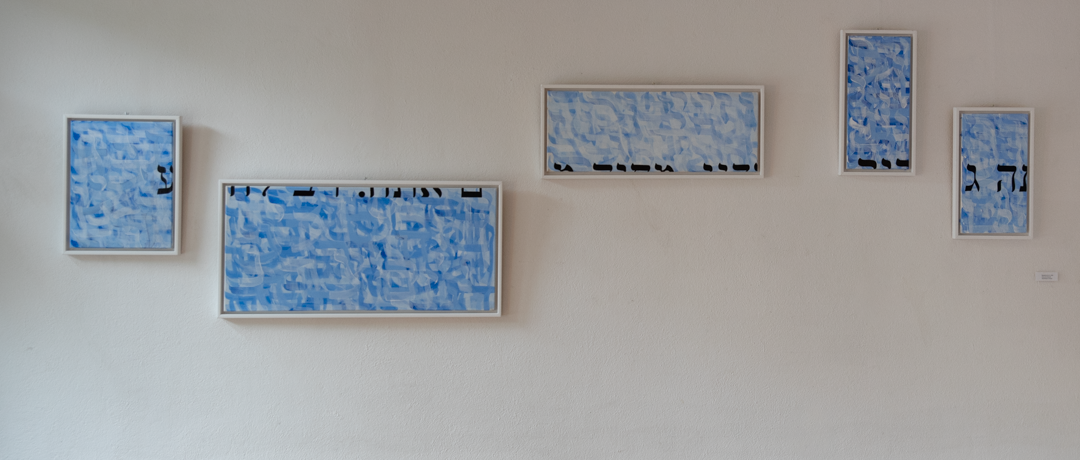
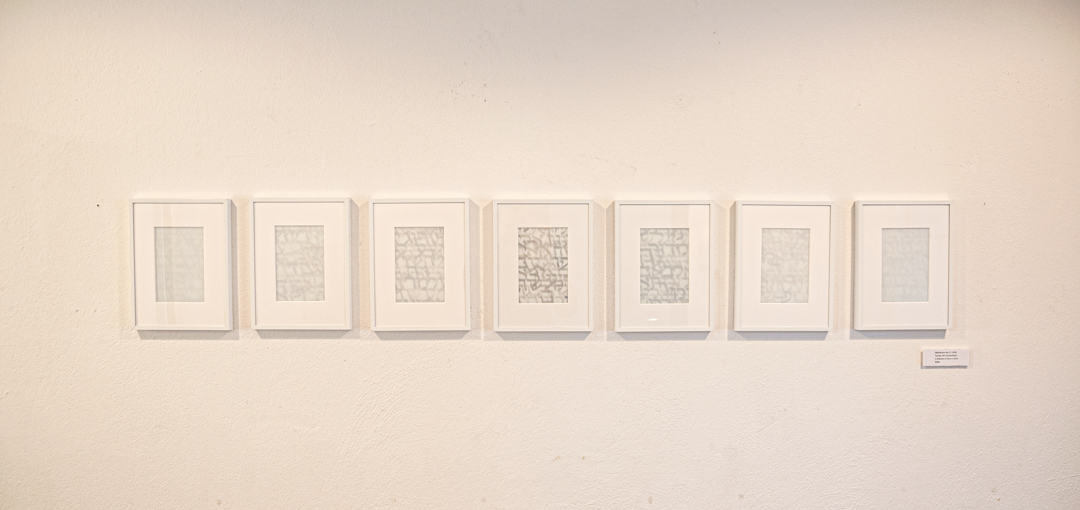
One of the sentences every praying Jew reads at least once per day is this quote. It’s part of the Amida, the Shmoneh Esreh, but appears a few more times in the Sidur.
As we are not supposed to pray by heart, but rather read the prayer every time, our eyes have seen this sentence thousands of times by the time we are grown up.
And yet, I’m not sure how I feel about the resurrection of the dead. And so every time I get to that part, I need to find a way to wholeheartedly pray, but to carefully not listen. To look at the text but to look away. To mean it without believing it.
When it’s both there and isn’t, when it’s recognizable but peripheral, I can live with it.
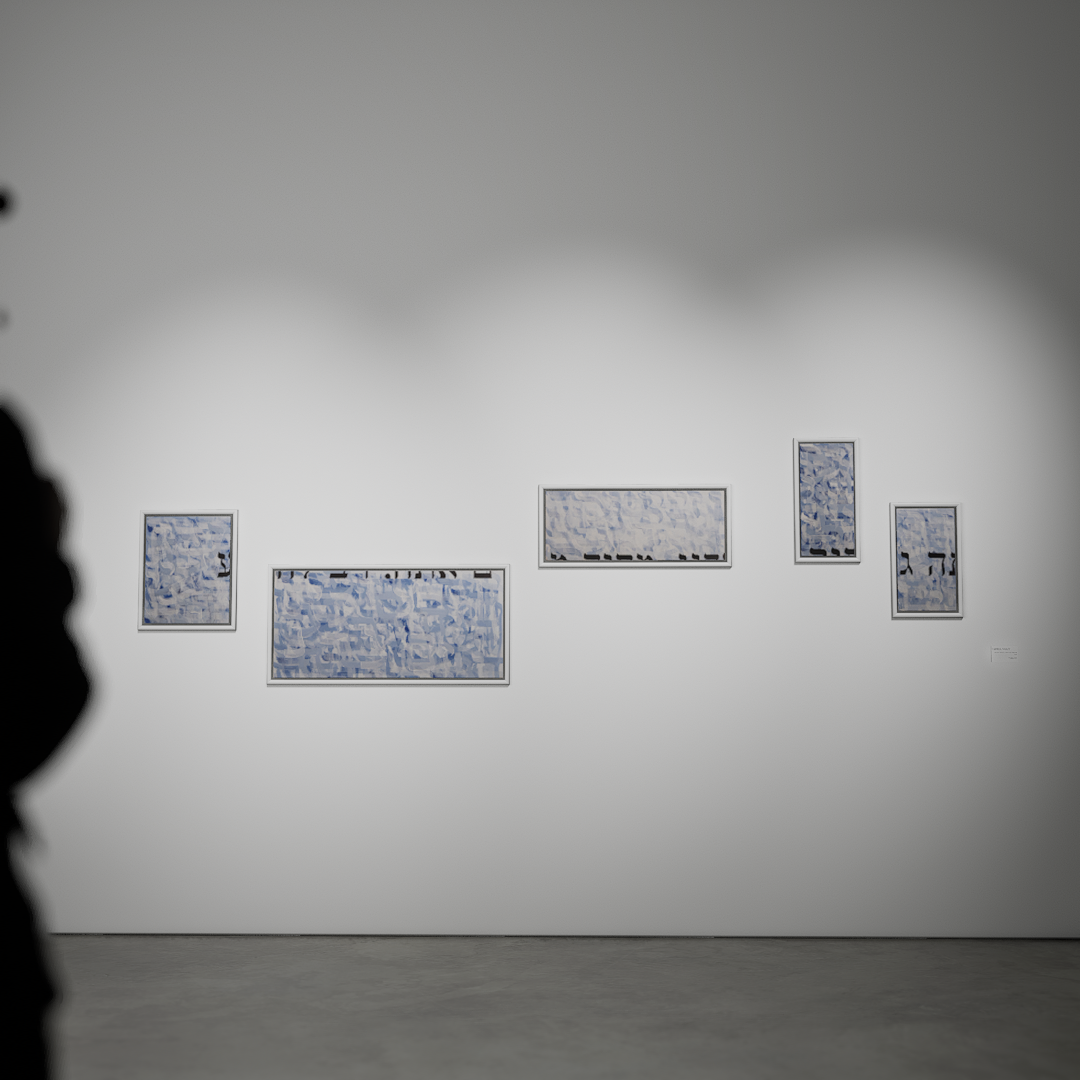
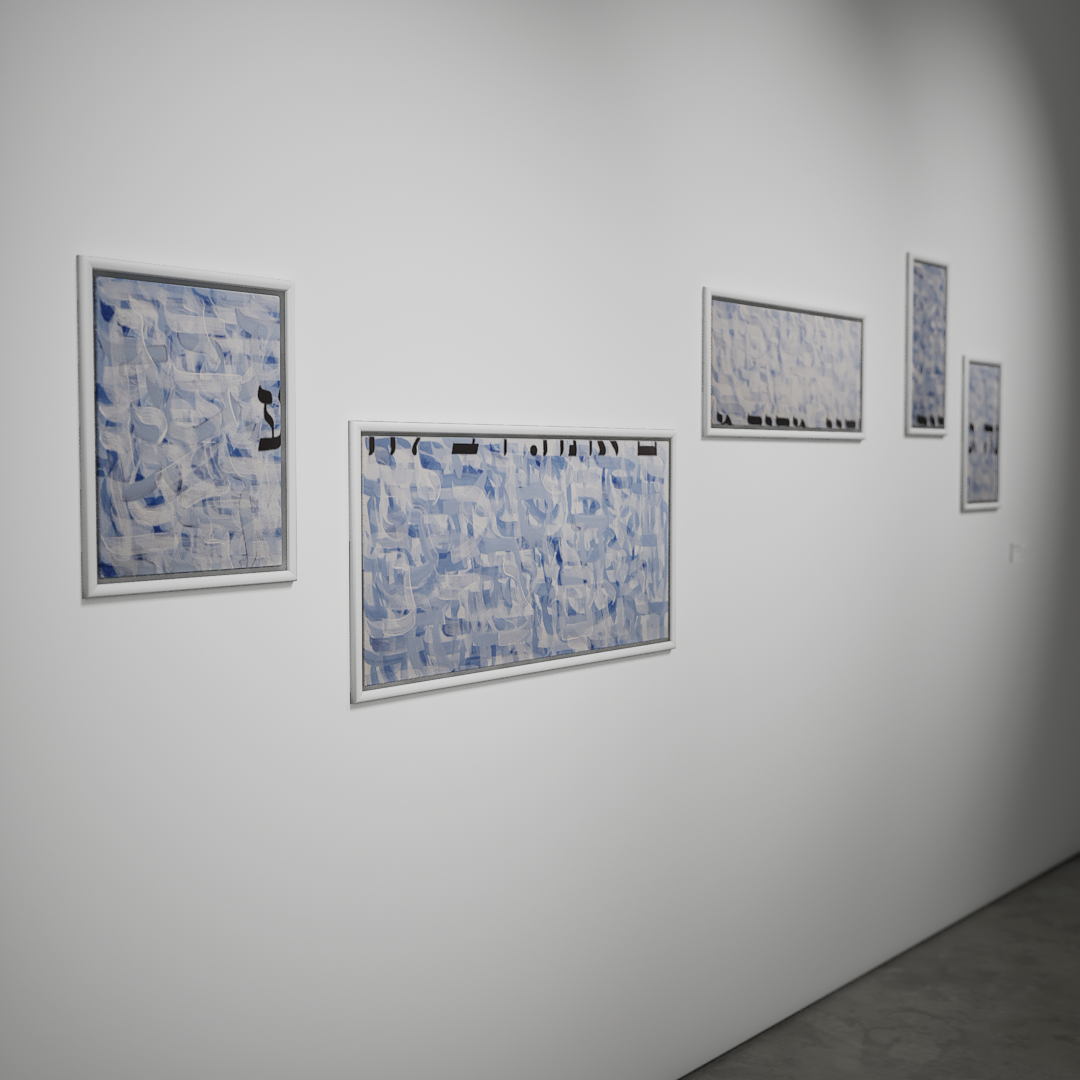
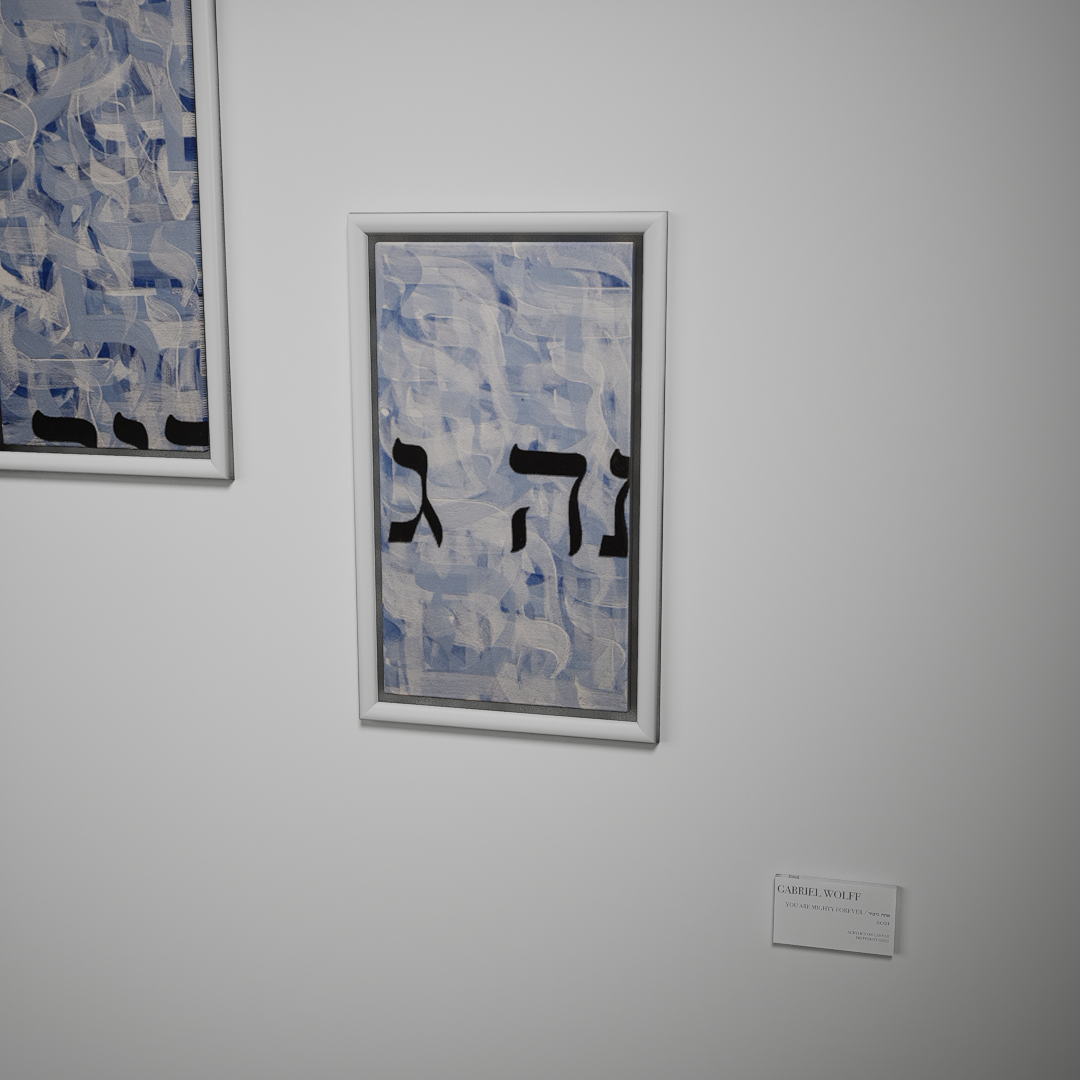
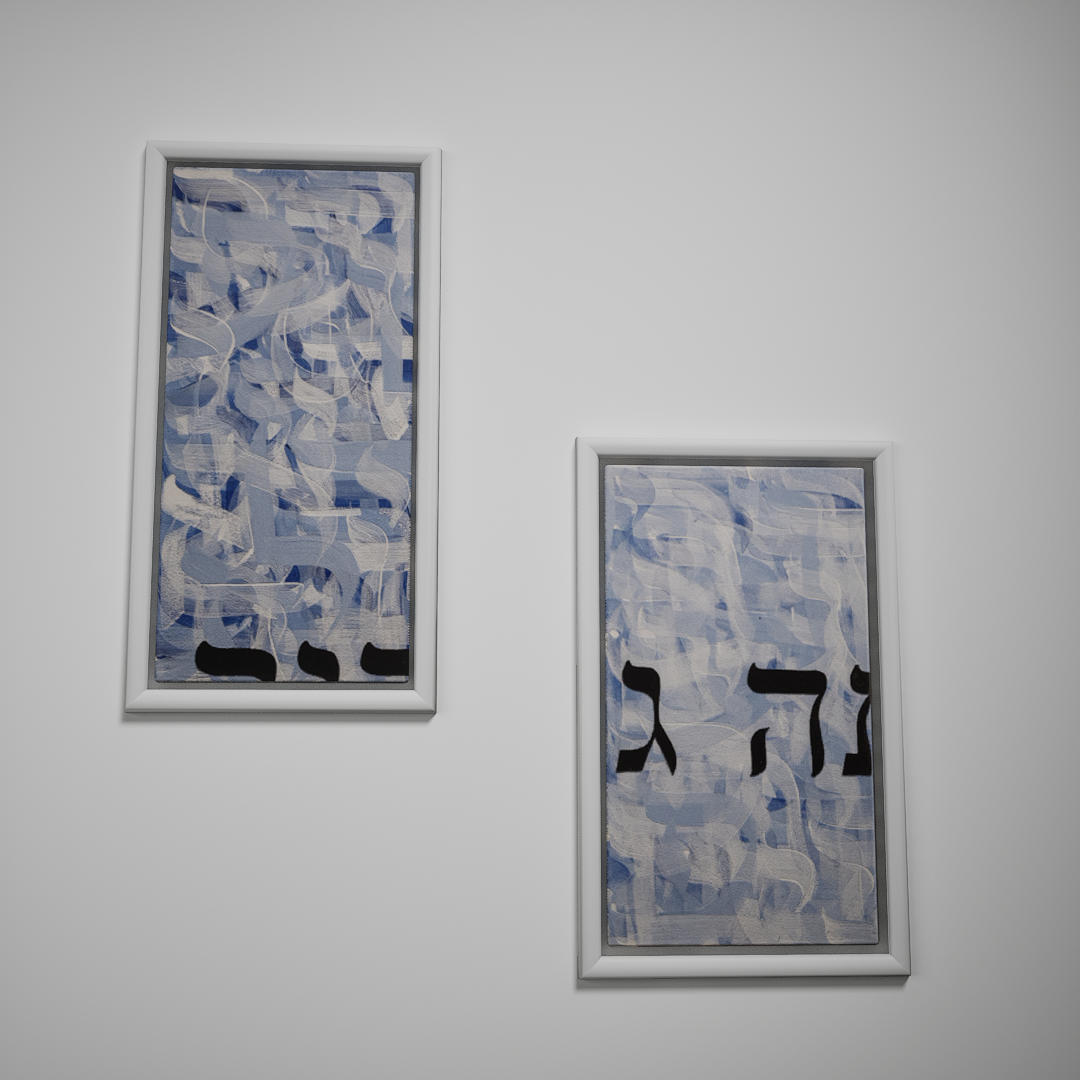
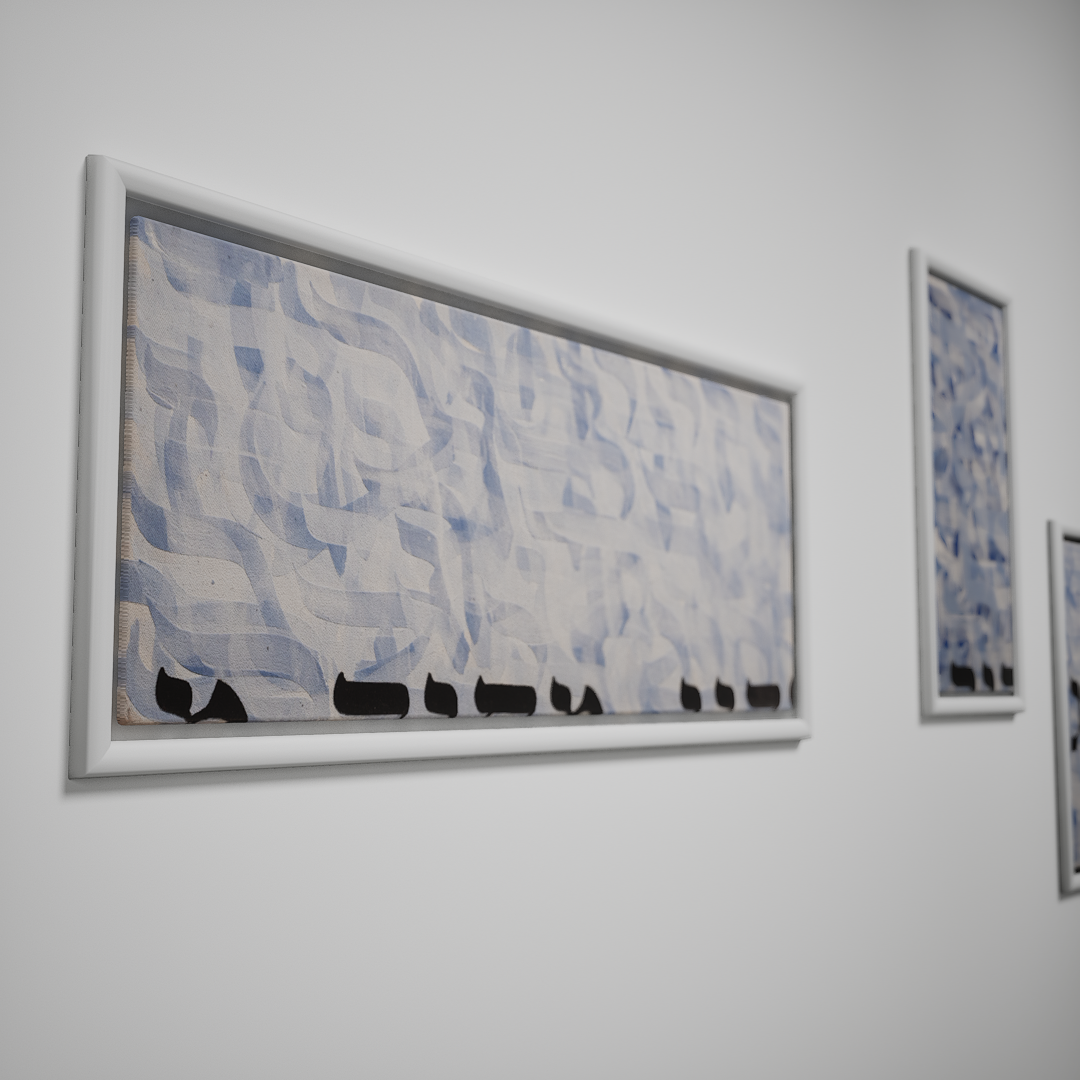
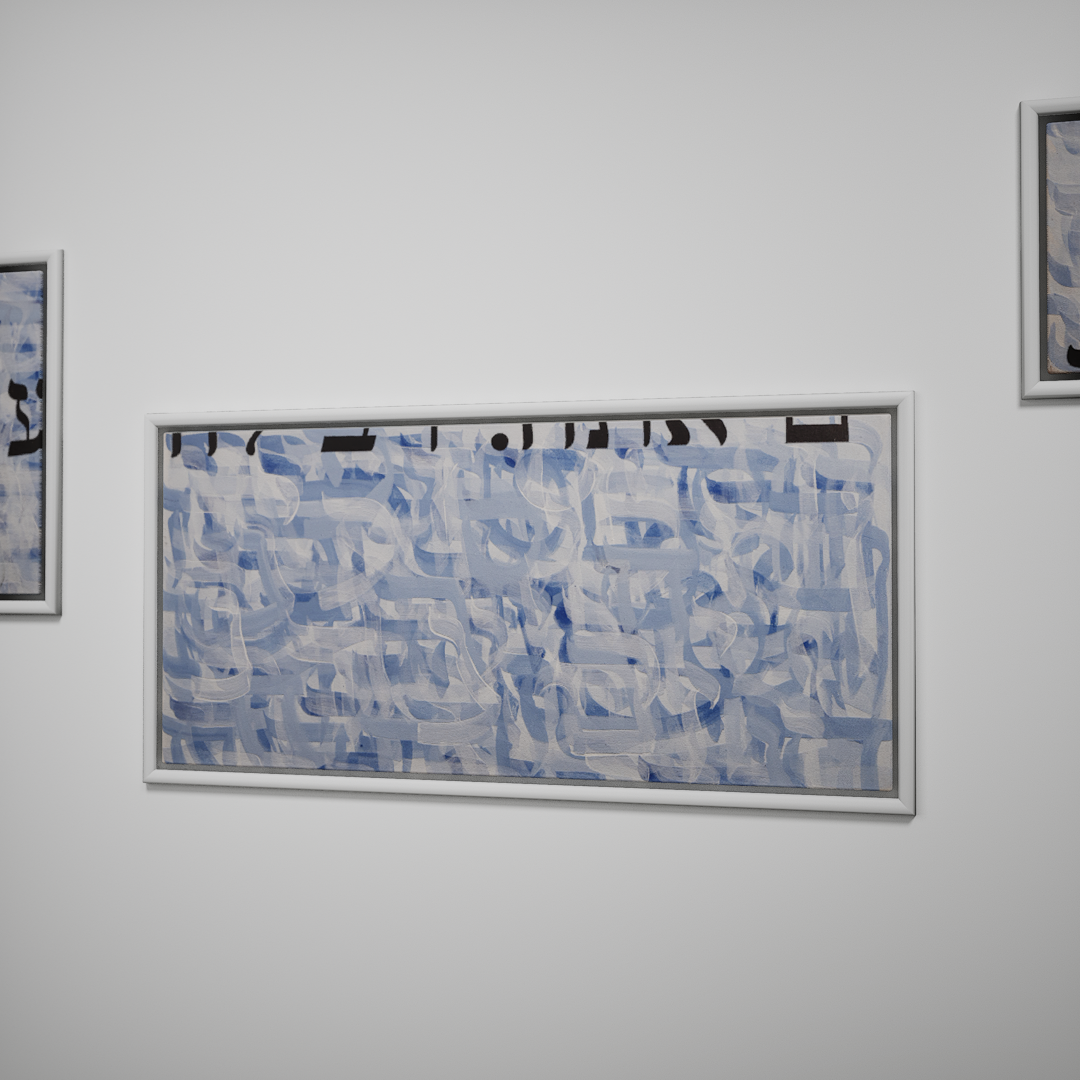
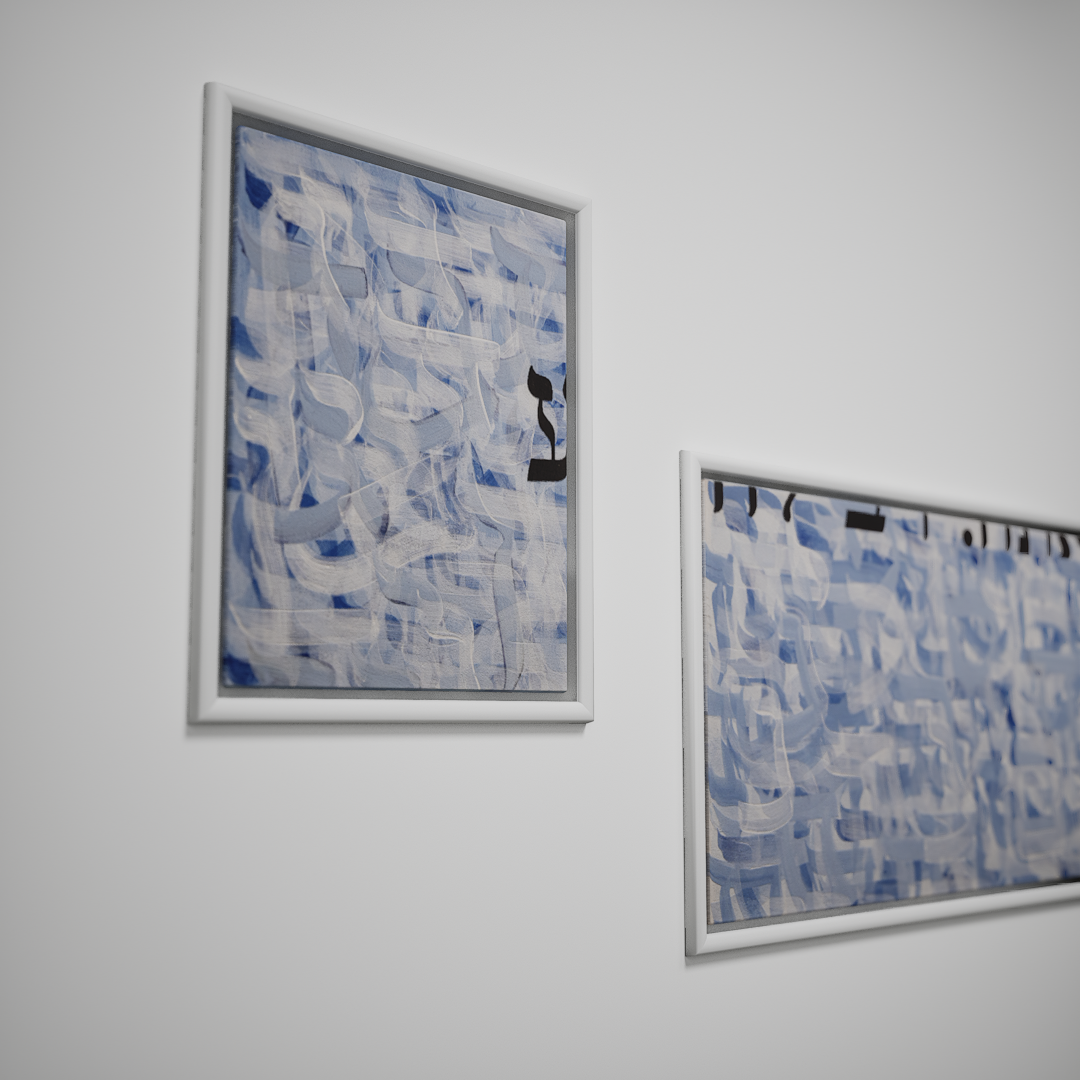
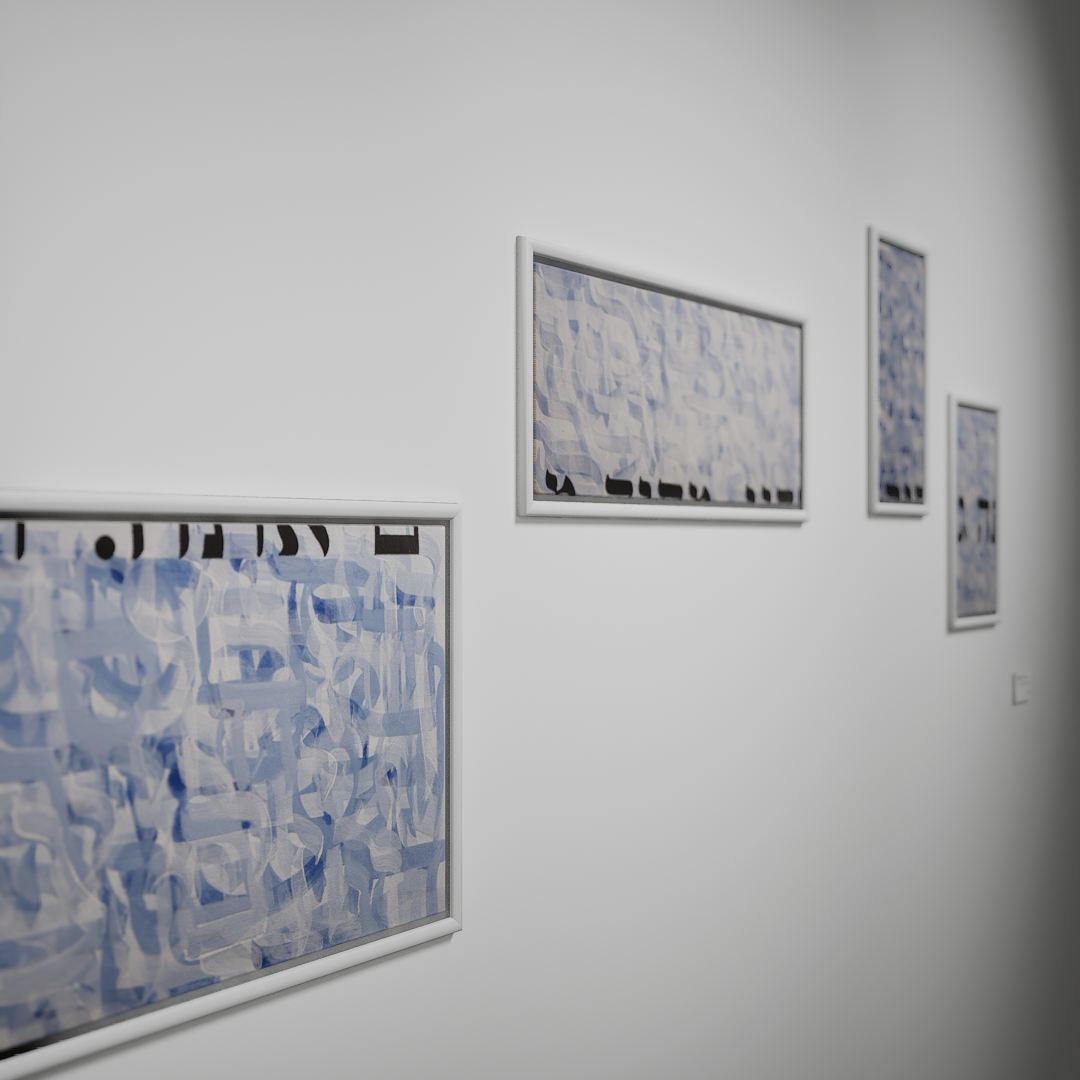
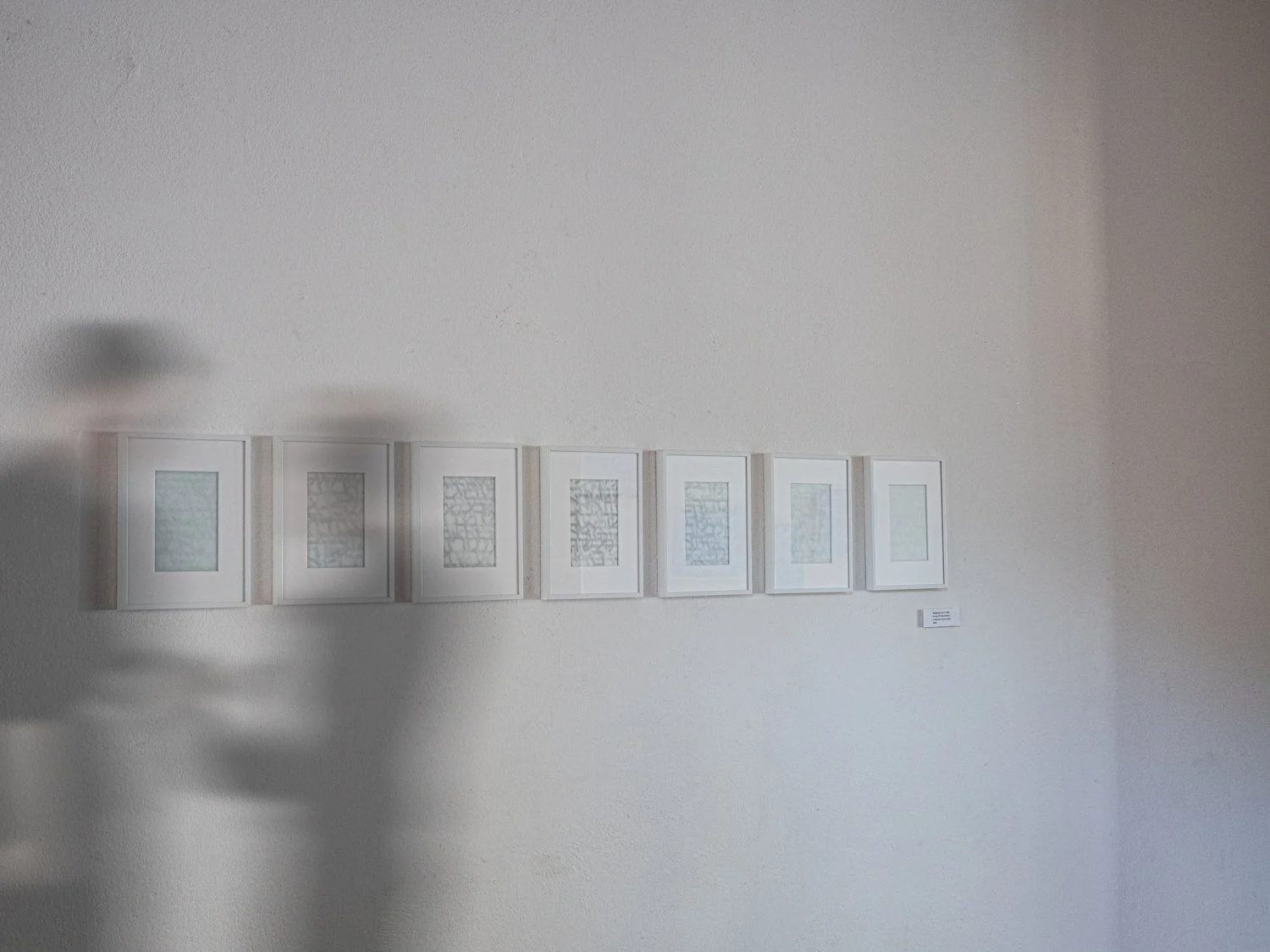
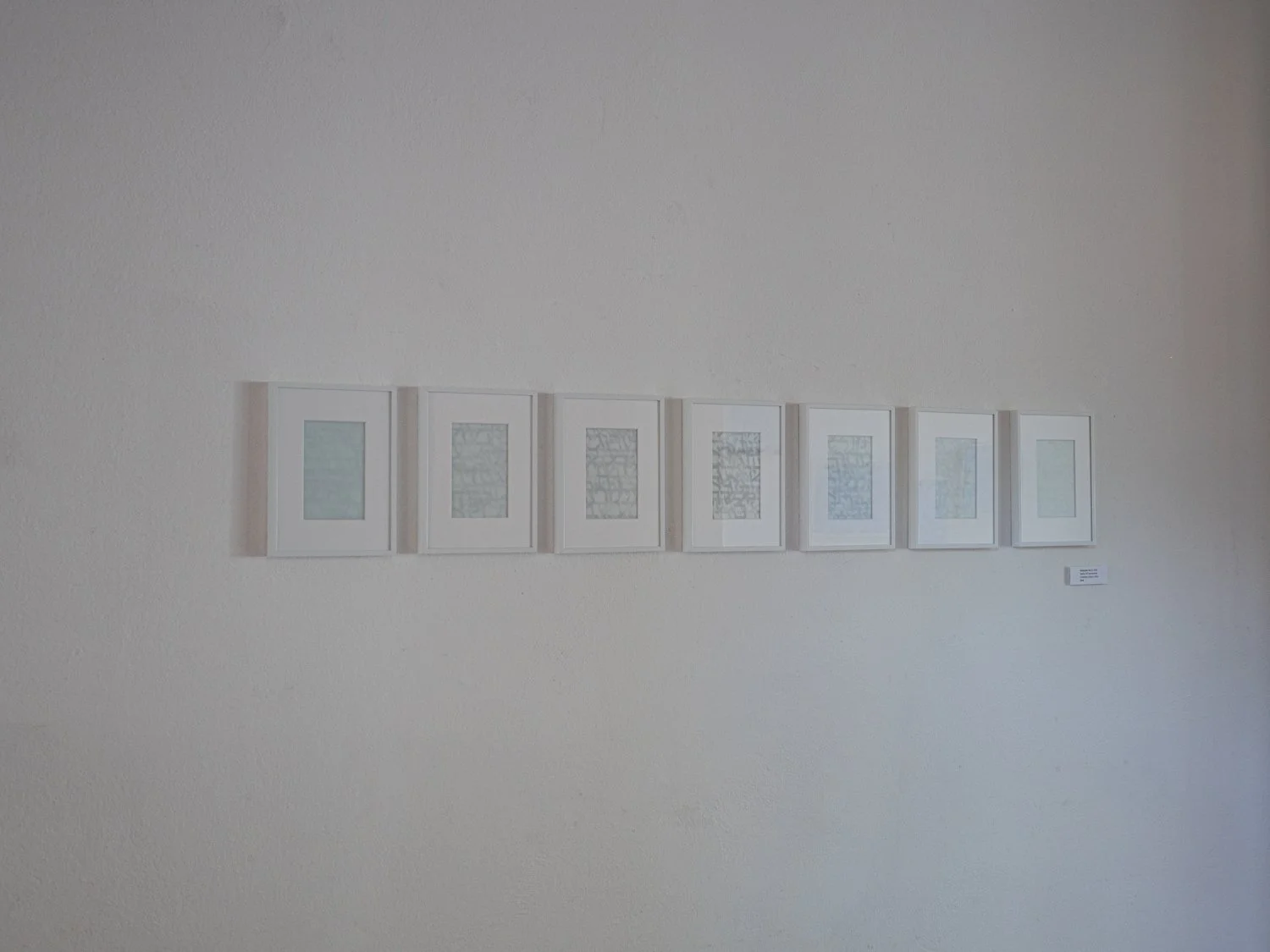
Tfilat haDerech x17
תפילת הדרך
Tfilat haDerech
Liturgy
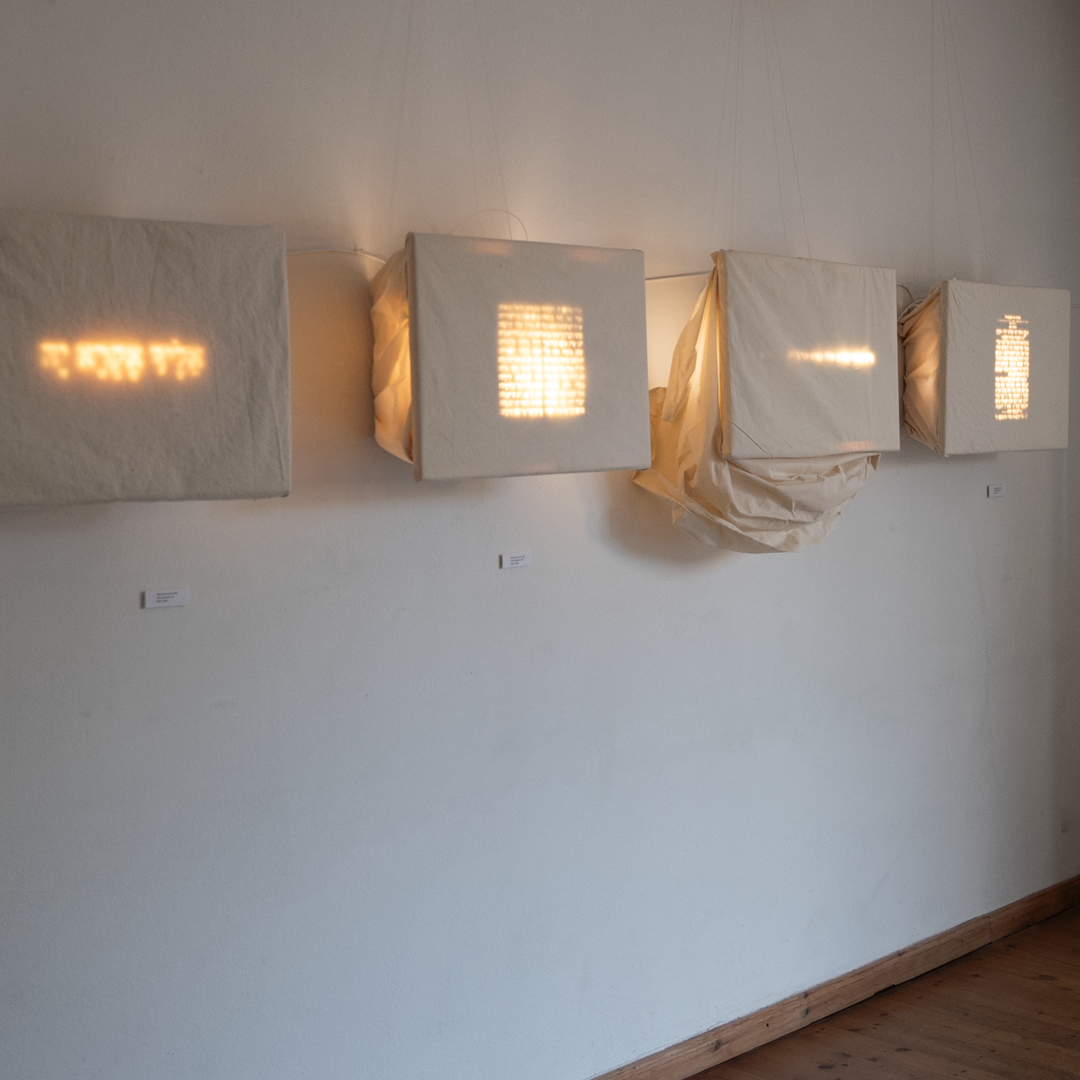
Another attempt at visualizing the fine line between seeing and not seeing, between acknowledging and ignoring is this work.
Tefilat HaDerech or the Traveler’s Prayer or Wayfarer’s Prayer in English, is a prayer for a safe journey recited when we travel, by air, sea, and even on long car trips. It is recited at the onset of every journey.
In this work from 2021, the eye of the viewer travels forth and back between the centerpiece, with its overlapping letters, illegible due to its density, and the outer pieces, less intertwined, less dense, but too transparent to really read. No matter how much the viewer looks for it, there is no sweet spot. The text either too dense or too transparent, making it impossible to read, every time sending the gaze from one extreme back to the other.
Form over function
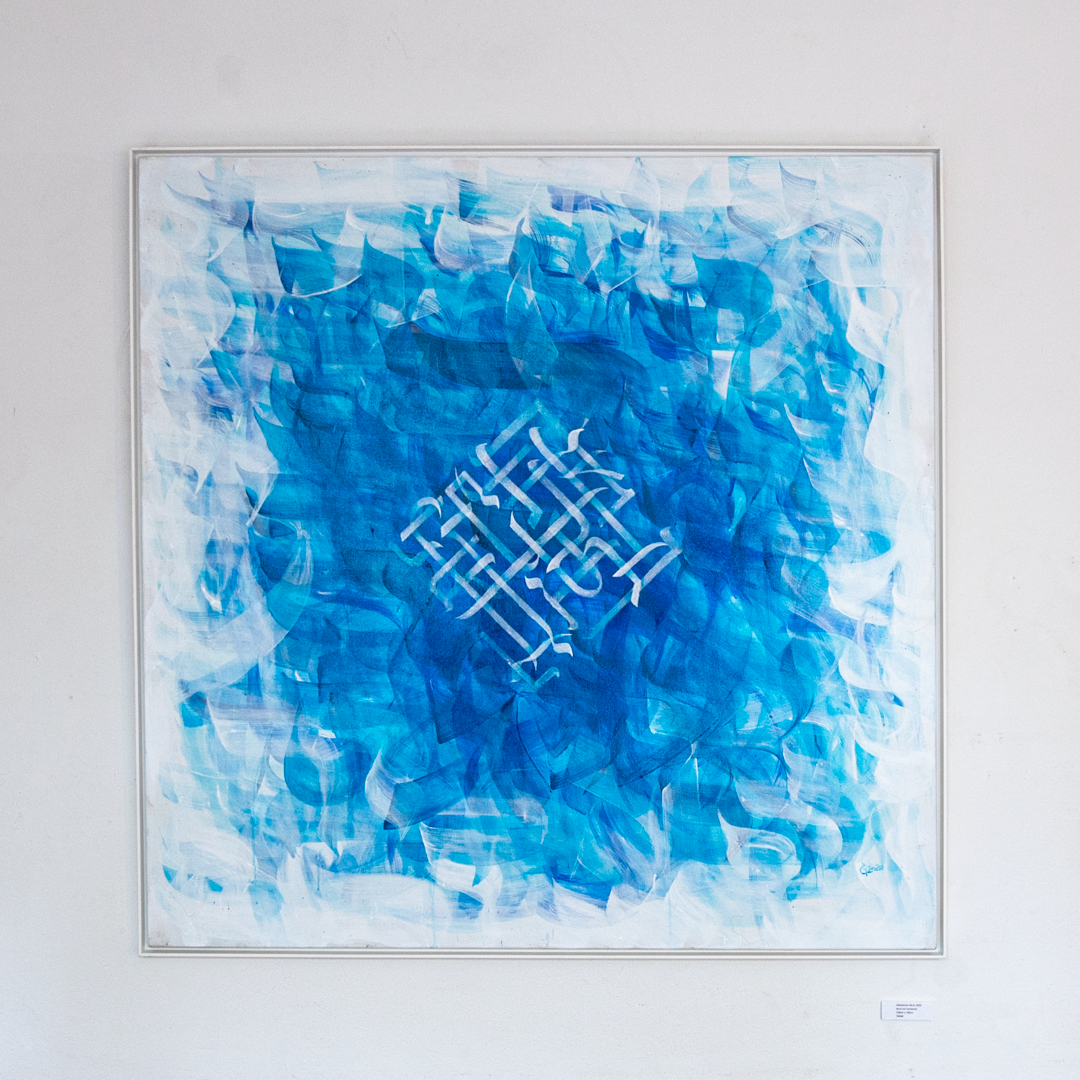
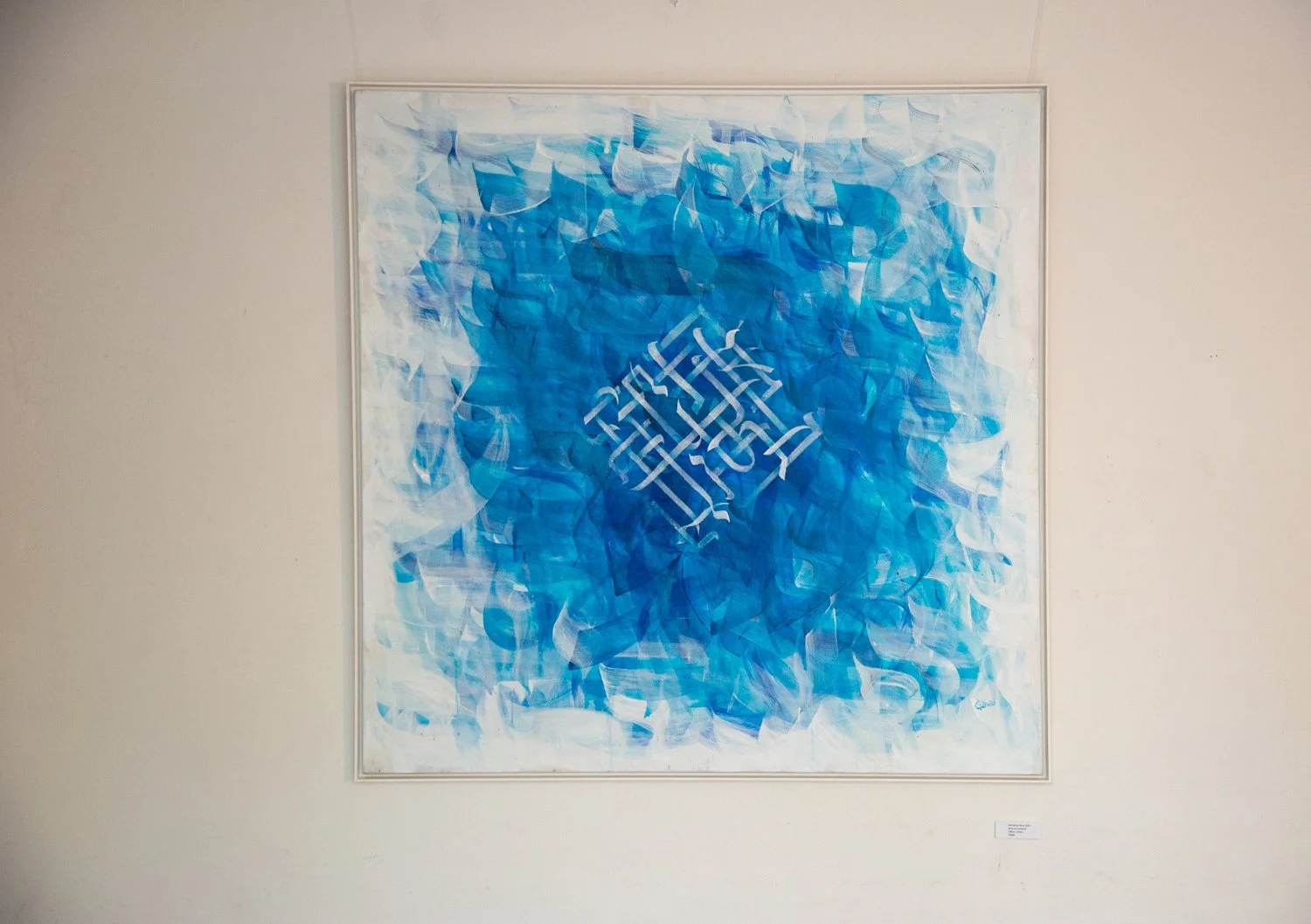
This work on canvas is an attempt at aiming directly at the core of our ability to read: letters themselves.
It is an exception in the body of my work because none of it are actually letters or words. I deconstructed letters and reconstructed them as forms that are clearly recognizable as Hebrew letters due to their aesthetics, but illegible as such because none of the forms is truly a Hebrew letter. The forms in this work are the abstraction of a Hebrew text.
We can hence engage in the act of “reading” but at the same time avoid its central function, the conveying of meaning.
Artist statement
I spent my first 12 years in Munich. Just like about any Jewish kid in Munich, I went to Judaism classes once a week, learned how to read, how to pray, how to count in Hebrew. One thing I didn’t learn until we immigrated to Jerusalem, is to speak Hebrew.
So my first recollection of prayer, of reading the Torah and learning verses by heart, of making letters into Hebrew sounds, coming out of my mouth, is an almost absurd one: it was the pronunciation of a dead language with absolutely no meaning to me. The meaning was in the form, in the melody, the occasion, the experience. But the words I sang were stripped of their basic function: to convey meaning.
I remember a specific instance, asking my teacher, Mrs. Figdor, for a translation of the Shema. I must have been about 7 or 8 at that time. She did her best to tell me what I was singing. At the same time, she seemed surprised at my demand for the text to have any literal meaning. Praying was the aim, for her. Not understanding the prayer’s words.
In the end, she won me over and I learned how to pray with kavana, being fully immersed in the act of uttering unintelligible syllables, honestly feeling the divine presence through words that could have been Klingon language, as far as I was concerned.
Today I’m in my late 30s. Having spent my teenage years and most of my 20s in Jerusalem, Hebrew has become a native language to me. I speak Hebrew with my kids and friends, read Hebrew books and newspapers, write down shopping lists and reminders in Hebrew.
And I still pray in Hebrew.
Through 3 further immigrations, each with nothing but a backpack, there are only two things I never left behind or gave away: my childhood Siddur and my Tallith. I still pavlovically cover my eyes at the beginning of any Shema, I feel my body melting into any Kaddish I say and any Amida will spiritually connect me to a sky, empty of anything divine. I stand in temple on Yom Kippur, shockeling with goosebumps and tears in my eyes, honestly asking for forgiveness from a God of whom I’m pretty sure doesn’t exist, and who, if he does exist, most definitely doesn’t care about my shockeling.
I’m an agnostic. Off the derech is an understatement. I work on Shobbes, love shrimp, will buy kosher meat for exuberant prices only to then fry it in butter. Looking for guidance, I’ll read Sartre, rather than the Rambam. I’m repelled by large parts of almost any prayer, probably simply because I was not born in the Middle Ages and was brought up by humanists.
So my praying is a never ending balancing act. Picking up my Siddur, I have to wipe out the last 25 years of my life and a whole language, time and again, in order to connect to that kid who consumed Hebrew words almost as if it was music.
It is, thus, again the act of stripping the words of their most basic functionality, the carrying of specific and immediate meaning, that makes them accessible to me in their meta-functionality, the carrying of heritage, history and roots. Making myself opaque to most of the ideas the prayers convey allow me to be absorbed in the act of praying, to uncynically connect to something I cannot rationally accept.
It’s an act of alienation, attempting at bridging a gap.
As such, it is an act of abstraction. The words of prayer, having ceased to convey specific meaning, turn into generic “holy words of my ancestors”, similar to the notes in a piece of music which may not carry a specific, concrete message, but may well arouse deep, complex, and authentic (and often specific and concrete) feelings.
And while the specific necessity of blinding myself to the very words I say in my native language, in order to surrender to them, may be the result of a clash of ideas most common to our modern times, the idea of abstraction in Jewish thought definitely isn’t.
In fact, I would like to claim that the act of abstraction is a very basic/primal concept in Judaism. It is almost omnipresent in Jewish thought, appearing in various different ways and lays at the bottom not only of Jewish thought processes but rather of Jewish philosophy as a whole.
In fact, there are two “movements” common in Judaism that can be seen as an attempt at abstraction.
The first, easily visible, is the abstraction that lays at the heart of monotheism itself: the abstract God. The sages who conceptualized the Biblical deity went to great length, creating a deity about which nothing positive was to be said. It had no form, no specific place, no features. Even pronouncing its name, something that would have given it some tangibility, was forbidden. Maimonides, in his Guide for the perplexed, goes to great length, describing how any attempt at describing God in any way is heresy, establishing the via negativa as the mainstream way to (not) describe God:
Know that when you make an affirmation ascribing another thing to Him, you become more remote from Him in two respects: one of them is that everything You affirm is a perfection only with reference to us, And the other is that He does not possess a thing other than His essence …
God's existence is absolute and it includes no composition and we comprehend only the fact that He exists, not His essence. Consequently it is a false assumption to hold that He has any positive attribute [...] still less has He accidents (מקרה), which could be described by an attribute. Hence it is clear that He has no positive attribute however, the negative attributes are necessary to direct the mind to the truths which we must believe [...] When we say of this being, that it exists, we mean that its non-existence is impossible; it is living — it is not dead; [...] it is the first — its existence is not due to any cause; it has power, wisdom, and will — it is not feeble or ignorant; He is One — there are not more Gods than one [...] Every attribute predicated of God denotes either the quality of an action, or, when the attribute is intended to convey some idea of the Divine Being itself — and not of His actions — the negation of the opposite.
A slightly less tangible aspect of abstraction omnipresent in Jewish thought is the way text is handled in Talmudic tradition. It is maybe most clearly exemplified in the concept of the Pardes. According to the idea of the Pardes, there are 4 separate layers to any Biblical text. These layers include
Peshat (פְּשָׁט) – "surface" ("straight") or the literal (direct) meaning.
Remez (רֶמֶז) – "hints" or the deep (allegoric: hidden or symbolic) meaning beyond just the literal sense.
Derash (דְּרַשׁ) – "inquire" ("seek") – the comparative meaning, as given through similar occurrences.
Sod (סוֹד) – "secret" ("mystery") or the esoteric/mystical meaning, as given through inspiration or revelation.
And make no mistake: the fourth and even third layers are often pretty far fetched. In other words: the idea of a text conveying meaning that isn’t to be found in the simple signification of the words, but rather hides behind it and is accessible only by moving the immediate meaning out of the way, is something Jews came up with long before anyone was busy with secular ideas.
This is not to say that I’m furthering the tradition of Jewish mystics. But every so often, when I find myself doing stuff that seems to make little or no sense, I look back to the history of my family or of my people and find an explanation for my behavior there. Sometimes, the explanations are to be found in traumata. We’re Jews, after all. But in other cases, I find parallels in seemingly unconnected areas. This may be one of them.
Credits
- Exhibition
- Gabriel Wolff
- Venue
- Stadtmission Berlin
- City
- Berlin, Germany